The best Morningstar Direct alternatives in 2026 are FactSet for institutional portfolio analytics, Bloomberg Terminal for real-time multi-asset data and risk, and YCharts for adviser research and client reports. No single platform replaces all of Morningstar Direct, so pick the one that covers the workflow your team uses most.
Teams usually leave Morningstar Direct over usability, speed and opaque pricing. Then they find that cheaper tools lack fund ratings and terminals lack manager research. Most switches replace one workflow, not the whole platform. In our review, none of the seven alternatives fully matched Direct’s public fund research and analyst ratings.
Shortlist Tools has no affiliate relationships with any company listed, and rankings are determined entirely by research data and objective evaluation criteria.
For narrower jobs, Nasdaq eVestment leads institutional manager selection, Koyfin suits tight budgets with published pricing, and PitchBook covers private markets, although Morningstar owns PitchBook. Each entry below shows its Shortlist Score and the workflow it fits best.
What Does “Morningstar Direct Alternatives” Mean?
In this article, “Morningstar Direct alternatives” means competing research platforms that can take over some or all of Morningstar Direct’s work. The term does not mean the alternative-investment data available inside Morningstar Direct. The right substitute also depends on which Morningstar product you are replacing.
- Morningstar Direct is built for research, asset-management and institutional teams, and its closest substitutes are FactSet, Bloomberg Terminal, Nasdaq eVestment and S&P Capital IQ Pro.
- Morningstar Direct Advisory Suite (formerly Advisor Workstation) is built for financial advisers, and its closest substitutes are YCharts and Koyfin.
Why Do Teams Look for a Morningstar Direct Alternative?
Morningstar Direct holds a verified G2 rating of 4.1/5 from 439 reviews, and 85.9% of those reviews give 4 or 5 stars (G2, November 2026). Most complaints are about usability and speed, not data. Opaque pricing and gaps in private-markets and separate-account coverage give teams more reasons to look elsewhere.
The most-mentioned G2 cons for Morningstar Direct are:
- Poor Usability is mentioned in 59 Morningstar Direct G2 reviews (G2, November 2026).
- Slow Performance is mentioned in 56 Morningstar Direct G2 reviews (G2, November 2026).
- Not User-Friendly is mentioned in 54 Morningstar Direct G2 reviews (G2, November 2026).
- Difficult Learning is mentioned in 39 Morningstar Direct G2 reviews (G2, November 2026).
- Data Inaccuracy is mentioned in 35 Morningstar Direct G2 reviews (G2, November 2026).
G2 does not list a price for Morningstar Direct (G2, November 2026). Buyers cannot work out savings from public data, so they need a written quote before comparing costs.
Each complaint points to a different alternative:
- Usability: Koyfin’s top G2 pro is Ease of Use, mentioned in 24 reviews (G2, November 2026).
- Cost opacity: Koyfin publishes full pricing, and Bloomberg Terminal’s reported per-seat price is the most consistent of the enterprise tools (ThePricer, 2025).
- Coverage gaps: Nasdaq eVestment covers separate accounts, and PitchBook covers private markets.
- Attribution and Excel workflows: FactSet Portfolio Analysis and S&P Capital IQ Pro’s Excel tools cover attribution and spreadsheet modelling.
What Are the 4 Categories of Morningstar Direct Alternatives?
Morningstar Direct alternatives fall into four categories:
- multi-asset workstations
- adviser research and reporting platforms
- manager-research databases
- private-markets databases
Workstations offer breadth. Adviser platforms cost less. Specialist databases go deeper than Direct on one job, such as manager selection or private funds.
- Multi-Asset Workstation: Multi-asset workstations are broad institutional platforms that combine market, company and portfolio data with analytics and Excel or API delivery. FactSet, Bloomberg Terminal and S&P Capital IQ Pro are in this category.
- Adviser Research & Reporting Platform: Adviser research and reporting platforms are lower-cost tools for screening, model portfolios, proposals and branded client reports. YCharts and Koyfin are in this category.
- Manager-Research Database: A manager-research database covers manager-reported institutional strategies, separate accounts and mandate intelligence. Nasdaq eVestment is the ranked entry.
- Private-Markets Database: A private-markets database covers private companies, deals, funds, LPs and GPs. PitchBook is the ranked entry.
Users on r/investing noted:
“It’s kinda hard to equate Bloomberg/Factset with low cost providers because both Bloomberg and Factset also aggregate and distribute a lot of third-party data. So it really depends on what datasets you are looking for. The usual comparisons are with S&P Capital IQ and whatever the Thompson-Reuter’s products became after the LSE bought them. But I think those platforms are in the same price range as Bloomberg and Factset.” Posted by u/greytoc
Takeaway: Research-platform buyers cannot compare enterprise workstations with low-cost tools on price alone, because the real difference lies in which datasets each category licenses and delivers.
How Does Each Alternative Compare with Morningstar Direct by Workflow?
None of the seven alternatives fully matches Morningstar Direct for public fund and ETF research with analyst ratings. Several match or beat Direct on narrower jobs:
- FactSet and Bloomberg Terminal for portfolio analytics
- Nasdaq eVestment for manager selection
- PitchBook for private markets
- YCharts and Koyfin for adviser reporting
| Workflow | Best Fit Among the Seven | How It Compares with Morningstar Direct |
|---|---|---|
| Public fund and ETF research, analyst ratings | None is a full equivalent | Direct remains stronger |
| Portfolio and risk analytics, attribution | FactSet (PA), Bloomberg Terminal (PORT) | Equal or stronger, multi-asset |
| Institutional manager selection, separate accounts | Nasdaq eVestment | Stronger for consultant and mandate data |
| Private markets | PitchBook, S&P Capital IQ Pro (via Preqin); FactSet Cobalt for private-capital document ingestion only | Stronger (PitchBook is Morningstar-owned) |
| Adviser proposals and client reporting | YCharts, Koyfin | Comparable, simpler and cheaper |
| Company, deal and Excel modelling | S&P Capital IQ Pro, FactSet | Stronger |
| Real-time markets, news and messaging | Bloomberg Terminal | Far stronger |
How Do the Top Morningstar Direct Alternatives Compare at a Glance?
The table below compares the seven alternatives on Shortlist Score, category, audience, Direct jobs covered, strength and limitation. FactSet ranks first overall at 4.03/5, and Bloomberg Terminal ranks second at 3.80/5. Workflow fit matters more than the numbered rank, because each product covers a different share of Morningstar Direct’s work.
| Rank | Company | Category | Best For | One-Line Summary | Key Capabilities | Primary Strength | Key Limitation |
|---|---|---|---|---|---|---|---|
| 1 (Score 4.03/5) | FactSet | Multi-Asset Workstation | Institutional portfolio analytics | FactSet is the closest institutional all-rounder to Morningstar Direct for attribution and multi-asset data. | PA attribution, Excel add-in, APIs, 800+ data sources. Covers Direct jobs: portfolio analytics and attribution, multi-asset data, Excel/API delivery; private-capital document ingestion (Cobalt) | ASV retention above 95% (FactSet FY2025 10-K, 2025) | Fund-research depth unverified |
| 2 (Score 3.80/5) | Bloomberg Terminal | Multi-Asset Workstation | Real-time multi-asset data and risk | Bloomberg Terminal is the leading Morningstar Direct alternative for real-time multi-asset data and PORT risk, but it is weaker for fund research and reporting. | PORT, FSRC, BQL, IB messaging. Covers Direct jobs: portfolio risk, fund screening | G2 4.4/5 from 69 reviews (G2, November 2026, verified) | No analyst ratings or manager research |
| 3 (Score 3.45/5) | YCharts | Adviser Research & Reporting Platform | Advisers needing proposals and reports | YCharts is the most direct Morningstar alternative for adviser research and client reporting. | Screeners, model portfolios, stress tests, proposals. Covers Direct jobs: fund screening, client reporting | T3 Software All-Star, 8.37/10 (T3/Inside Information, 2025) | No proprietary ratings or institutional research |
| 4 (Score 3.30/5) | S&P Capital IQ Pro | Multi-Asset Workstation | Company, deal and private-company work | S&P Capital IQ Pro is a strong Direct alternative for company and deal analysis, not fund research. | Private-company and PE/VC fund data, ChatIQ, Excel tools. Covers Direct jobs: private markets, Excel modelling | 60M+ private companies and 110,000+ PE/VC funds (S&P Global, 2026, vendor-reported) | Weaker for fund research and reporting |
| 5 (Score 3.18/5) | Koyfin | Adviser Research & Reporting Platform | Small RIAs on a budget | Koyfin is the lowest-cost Morningstar Direct alternative in this list that has adviser-grade fund data and published pricing. | Dashboards, fund screener, proposals, custodian links. Covers Direct jobs: screening, adviser reporting | G2 4.8/5 from 137 reviews (G2, November 2026, verified) | No Excel export of screens; light fixed income |
| 6 (Score 3.13/5) | Nasdaq eVestment | Manager-Research Database | Manager selection and SMAs | Nasdaq eVestment is the strongest Direct alternative for institutional manager selection. | 30,000+ strategies, Market Lens, RiskPlus. Covers Direct jobs: manager research, peer groups | About $37T reported institutional assets (Nasdaq, Q3 2024, vendor-reported) | Highest modelled cost (vendor-commissioned Forrester model); weak for retail funds |
| 7 (Score 3.03/5) | PitchBook | Private-Markets Database | Private-markets fund and LP research | PitchBook is the strongest private-markets complement to Morningstar Direct, not a full replacement. | Deals, funds, LPs, GPs, benchmarks, Excel plug-in. Covers Direct jobs: private markets | #6 on G2’s Best Financial Services Software list (G2, 2026) | Morningstar-owned; no public-fund analytics |
Ownership and dependency note: Morningstar has owned PitchBook since 2016. YCharts sells Morningstar enhanced fund data as an add-on, and FactSet’s marketplace carries Morningstar reports, so some switches do not fully leave Morningstar.
Which Morningstar Direct Alternative Should I Choose for My Use Case?
Choose by your main workflow. YCharts suits adviser proposals, Koyfin suits budgets under $5,000 a year and Nasdaq eVestment suits manager selection. FactSet suits attribution, Bloomberg Terminal real-time risk, S&P Capital IQ Pro company and deal work, and PitchBook private funds. Teams that depend on Morningstar ratings should stay with Direct or compare content line by line.
| Your #1 Priority | Recommended Tool | Why | Acceptable Alternative |
|---|---|---|---|
| Adviser proposals and client reports | YCharts | Built-in proposals, model portfolios and branded reports | Koyfin |
| Budget under $5,000 per year | Koyfin | Published Advisor Core price of $209/month | YCharts |
| Manager selection and separate accounts | Nasdaq eVestment | 30,000+ strategies, including separate accounts | FactSet |
| Portfolio attribution | FactSet | Portfolio Analysis multi-asset attribution | Bloomberg Terminal |
| Real-time multi-asset risk | Bloomberg Terminal | PORT plus real-time data and news | FactSet |
| Company, deal and private-company analysis | S&P Capital IQ Pro | 60M+ private companies and Excel tools | FactSet |
| Private funds, LPs and GPs | PitchBook | Private-markets fund and LP coverage | S&P Capital IQ Pro |
| Reduce dependence on Morningstar | Koyfin, Bloomberg Terminal, S&P Capital IQ Pro or Nasdaq eVestment | No Morningstar ownership or data dependency found in our research | FactSet (marketplace includes optional Morningstar reports) |
| Dependence on Morningstar ratings | Stay with Morningstar Direct | Morningstar’s proprietary ratings are available only from Morningstar or through licensed add-ons such as YCharts’ Morningstar data | Compare content line by line with YCharts (Morningstar data add-on) |
The overall rank is not necessarily your rank. Nasdaq eVestment ranks sixth overall, but a consultant running manager searches would put it first. Its lower overall score comes mainly from cost, not capability.
1. FactSet: Best Overall for Institutional Portfolio Analytics and Attribution
Category: Multi-Asset Workstation, broad institutional platforms combining market, company and portfolio data with analytics and Excel/API delivery.
At a Glance
- Category: Multi-Asset Workstation
- Best For: Asset managers, consultants and large wealth firms replacing Direct’s portfolio-analytics and attribution workflow
- Price Range: Pricing on request (third-party price estimates: about $12,000/user/year base; $4,000–$50,000+ range)
- Primary Strength: FactSet combines multi-asset attribution, an Excel add-in and API delivery with audited ASV retention above 95% (FactSet FY2025 10-K, 2025).
- Biggest Limitation: FactSet’s fund-research depth, including Morningstar-style ratings and categories, is unverified and depends on the package bought.
- One-Line Summary: FactSet is the closest institutional all-rounder to Morningstar Direct for portfolio analytics, attribution and multi-asset data, but buyers should request a content inventory to confirm fund-research coverage.
- Last Verified: November 2026
Shortlist Score: 4.03/5 (C1 Coverage 4.0 · C2 Data 5.0 · C3 Reviews 3.5 · C4 Pricing 2.0 · C5 Adoption 5.0). FactSet ranks #1 because it combines the top data-delivery and audited-adoption scores with the widest institutional workflow coverage. It loses points on opaque pricing and unverified G2 figures.
Overview FactSet Workstation is a quote-based institutional research platform. It combines company, market, ownership, estimates and portfolio data with Portfolio Analysis attribution for asset managers, consultants and wealth firms replacing Morningstar Direct’s analytics workflow. FactSet delivers this data through an Excel add-in and APIs that are licensed separately.
FactSet’s fund and ETF coverage varies by package. Our research could not confirm whether FactSet’s fund data comes from Lipper or from FactSet’s own collection.
Key Features
- FactSet Portfolio Analysis (PA) provides multi-asset performance attribution and portfolio analytics.
- FactSet’s open data marketplace connects to more than 800 data sources, including third-party research such as Morningstar reports (TrustRadius, 2026).
- FactSet offers an Excel add-in, plus data feeds and APIs that are licensed separately.
- FactSet Mercury is a conversational AI tool for fundamentals, and FactSet released AI document search in beta to more than 85,000 users (FactSet press release, 2025).
- FactSet’s Cobalt product provides AI document ingestion for private-capital managers, rather than a private-markets database.
Best For FactSet is best for institutional teams whose Morningstar Direct use centres on attribution, Excel modelling and multi-asset data rather than Morningstar’s proprietary fund ratings.
Strengths
- FactSet reported ASV retention above 95% and client retention of 91% across 8,996 clients and 237,324 users as of August 31, 2025, the strongest audited retention evidence in this list (FactSet FY2025 10-K, 2025).
- FactSet’s organic ASV grew 5.7% year over year to $2.3709B in FY2025 (FactSet FY2025 Annual Report, 2025).
- FactSet holds 4.9/5 on Capterra (9 reviews), 4.5/5 on Gartner Peer Insights (10 reviews) and 4.3/5 on G2, all small-sample, unverified third-party snapshots (Capterra, Gartner and G2, 2026).
- FactSet reviewers praise its Excel and workstation integration, and one reviewer said FactSet cost less than Bloomberg (TrustRadius, 2026).
Limitations FactSet trades fund-research specificity for breadth. Our research could not verify Morningstar-style analyst ratings, category frameworks or the source of FactSet’s fund data, so teams that rely on ratings may still need a Morningstar licence.
- FactSet users report difficult navigation and trouble finding specific information (TrustRadius, 2026).
- FactSet’s quote-based pricing is in the same cost class as Morningstar Direct, so switching may not save money.
- FactSet’s Cobalt product handles private-capital documents only, so teams that need private-fund data will probably also need a private-markets database.
Users on r/finance shared their experience:
“FactSet is all I have used other than some CapIQ, but you nailed it. I love it and can get everything I want out of it, but the app and mobile desktop are so ridiculously awful” Posted by u/Hamburghini_Murcy
Takeaway: FactSet users value the depth of its data but criticise its desktop and mobile apps, which matches the navigation complaints on review platforms.
How It Compares with Morningstar Direct
- FactSet is stronger than Morningstar Direct for portfolio attribution, Excel and API workflows, and multi-asset data.
- FactSet’s peer-group analysis and fund-specific research depth are unverified and may be weaker than Morningstar Direct’s.
- FactSet is an independent public company, but its marketplace carries Morningstar reports, so some Morningstar content may stay in use after a switch.
Verdict FactSet is the strongest overall Morningstar Direct alternative for institutional teams that rely on portfolio attribution, multi-asset data and Excel or API delivery. FactSet’s audited ASV retention above 95% (FY2025) points to a durable platform. Teams that depend on Morningstar ratings should request a written content inventory and expect quote-based pricing.
2. Bloomberg Terminal: Best for Real-Time Multi-Asset Data, News and Portfolio Risk (PORT)
Category: Multi-Asset Workstation, broad institutional platforms combining market, company and portfolio data with analytics and Excel/API delivery.
At a Glance
- Category: Multi-Asset Workstation
- Best For: Portfolio managers and analysts who need real-time markets, news and multi-asset risk more than fund ratings
- Price Range: About $28,320–$31,980 per terminal per year (third-party price estimates for 2025; two-year contracts typical)
- Primary Strength: Bloomberg Terminal has the broadest real-time, multi-asset data, news and messaging coverage in this list.
- Biggest Limitation: Bloomberg Terminal has no Morningstar-style analyst ratings or manager research, and G2 reviewers favour Morningstar Direct for reporting.
- One-Line Summary: Bloomberg Terminal is a far stronger Morningstar Direct alternative for real-time multi-asset data and portfolio risk, but a weaker substitute for fund-focused research and client reporting.
- Last Verified: November 2026
Shortlist Score: 3.80/5 (C1 Coverage 3.0 · C2 Data 5.0 · C3 Reviews 4.0 · C4 Pricing 2.5 · C5 Adoption 4.5). Bloomberg Terminal matches FactSet on data breadth. It ranks second because it lacks analyst ratings, manager research and Direct-style reporting (C1 3.0).
Overview Bloomberg Terminal is a subscription desktop covering real-time multi-asset data, news, Bloomberg Intelligence research, fund screening and PORT risk analytics. It is built for portfolio managers and analysts who need market-wide coverage more than Morningstar-style fund ratings. Bloomberg Terminal also includes Instant Bloomberg messaging.
Bloomberg Terminal is sold through bloomberg.com/professional. G2 maps its listing to Bloomberg Industry Group, and the 1929 Arlington, VA founding date shown there belongs to that separate business.
Key Features
- Bloomberg Terminal’s PORT function provides portfolio analytics and risk across asset classes.
- Bloomberg Terminal’s FSRC function screens funds, and its HDS and FLNG functions show holdings, according to a training reference rather than an official specification (Texas State University Bloomberg guide, 2026).
- Bloomberg Terminal’s BQL query language returns normalised data for custom analysis.
- Bloomberg Terminal includes Bloomberg Intelligence research alongside real-time news.
- Bloomberg Terminal’s Instant Bloomberg (IB) messaging connects a community that Bloomberg describes as more than 350,000 decision-makers (Edgepedia, 2026, vendor-reported).
Best For Bloomberg Terminal is best for trading-adjacent portfolio managers, multi-asset analysts and risk teams for whom fund research matters less than real-time data and PORT analytics.
Strengths
- Bloomberg Terminal holds a verified G2 rating of 4.4/5 from 69 reviews, with 94.2% at 4 or 5 stars (G2, November 2026).
- Bloomberg Terminal had about 350,000 subscribers in 2024, according to Burton-Taylor as cited by The Telegraph (The Telegraph, 2024).
- Bloomberg Terminal reviewers on G2 praise its comprehensive real-time data, updates and customer support (G2, November 2026).
- Bloomberg Terminal’s reported 2025 prices agree across several independent pricing sources, which makes budgeting more predictable than for other enterprise tools (ThePricer and BlueGamma, 2025).
This aligns with community sentiment on r/bloomberg:
“The data availability on BB is far superior to anything you can get on any free platform that I’m aware of. Trading using IB is unrivaled… A phone can’t rival IB(instant message). I can get quotes from a dozen different traders in 30 seconds. It’s not a retail trader tool. It’s a professional tool. Factset/Refinitiv/CapIQ/IBKR don’t even come close on the pro side” Posted by u/IHateHangovers
Takeaway: Professional users see Instant Bloomberg messaging and data availability as Bloomberg Terminal’s moat, and they rank it ahead of FactSet and Capital IQ for trading-side work.
Limitations Bloomberg Terminal trades fund-research depth for market breadth. Bloomberg Terminal has no Morningstar-style analyst ratings or manager research, and G2 reviewers rate it below Morningstar Direct for data accessibility and reporting (G2, November 2026).
- Bloomberg Terminal’s interface is described by G2 reviewers as hard for newcomers (G2, November 2026).
- Bloomberg Terminal costs about $28,000–$32,000 per seat per year, so it rarely cuts cost for a team leaving Direct (ThePricer, 2025).
- Bloomberg Terminal’s typical two-year contracts commit a single-seat buyer to about $63,960 before long-term fit is proven (ThePricer, 2025).
How It Compares with Morningstar Direct
- Bloomberg Terminal is far stronger than Morningstar Direct for real-time markets, news and messaging, and equal or stronger for multi-asset risk via PORT.
- Bloomberg Terminal is weaker than Morningstar Direct for analyst ratings, manager research, peer-group analysis and reporting.
- Bloomberg Terminal is owned by Bloomberg L.P., is independent of Morningstar and costs more per seat than most alternatives.
Verdict Bloomberg Terminal is the best Morningstar Direct alternative for teams that need real-time multi-asset data, news and PORT portfolio risk on one desktop. Bloomberg Terminal’s verified 4.4/5 G2 rating and roughly 350,000 subscribers show broad institutional adoption. Fund-research teams often run Bloomberg Terminal alongside Direct, because it is weaker for ratings and reporting.
3. YCharts: Best for Financial Advisers Needing Research, Proposals and Client Reports
Category: Adviser Research & Reporting Platform, lower-cost tools for screening, model portfolios, proposals and branded client reports.
At a Glance
- Category: Adviser Research & Reporting Platform
- Best For: RIAs and mid-size wealth firms replacing Morningstar’s adviser research and client-reporting workflow
- Price Range: About $3,000–$6,300/year for the first seat depending on tier (reported, unverified); 7-day free trial
- Primary Strength: YCharts combines fund and stock screening, model portfolios, stress tests and branded proposals in one adviser workflow.
- Biggest Limitation: YCharts has no proprietary analyst ratings and is not built for institutional manager research.
- One-Line Summary: YCharts is the most direct Morningstar alternative for advisers who need research, proposals and client reports in one platform, though it lacks proprietary fund ratings and institutional manager research.
- Last Verified: November 2026
Shortlist Score: 3.45/5 (C1 Coverage 3.5 · C2 Data 3.0 · C3 Reviews 4.0 · C4 Pricing 3.5 · C5 Adoption 3.5). YCharts outranks two enterprise workstations because it covers more of the adviser-facing Direct jobs, and independent T3 2025 survey evidence supports that coverage.
Overview YCharts is an adviser-focused research and client-communication platform. It offers fundamental charts, fund and stock screeners, model portfolios, stress tests and branded proposals for RIAs and wealth firms replacing the adviser-facing parts of Morningstar’s toolkit. The closest Morningstar comparison for YCharts is Morningstar Direct Advisory Suite.
YCharts sells Morningstar enhanced fund data as an optional add-on. Switching to YCharts may therefore not end a firm’s Morningstar data licence.
Key Features
- YCharts Fundamental Charts cover more than 4,000 metrics, with screeners for stocks, ETFs, mutual funds, closed-end funds and indexes (The Family Office Stack, 2026).
- YCharts Model Portfolios support dated weights and attribution, alongside Scenarios, stress tests and an optimizer.
- YCharts includes a Risk Profiler, Proposals and branded client reports for adviser meetings.
- YCharts offers an Excel add-in for analysts who build models in spreadsheets.
- YCharts integrates with Orion, Redtail, Salesforce, eMoney and custodians (RFP.wiki, 2026).
Best For YCharts is best for independent RIAs and mid-size wealth firms whose Morningstar use centres on fund screening, model portfolio comparisons, proposals and client-ready charts.
Strengths
- YCharts was named a T3 2025 Software All-Star in Investment Data & Analytics with an 8.37/10 average user rating (T3/Inside Information Software Survey, 2025). YCharts also reports a second All-Star rating of 8.36 in Economic Analysis & Stress Testing (YCharts, 2025, vendor-reported).
- YCharts scored 8.2/10 for satisfaction and 8.3 for perceived value (Kitces AdvisorTech, 2025, as summarised by YCharts).
- YCharts reports that its T3 market share rose from 8% in 2022 to about 15% in 2025 (YCharts, 2025, vendor-reported), while Morningstar’s adviser share declined gradually (T3/Inside Information Software Survey, 2025).
- YCharts reviewers praise its adviser workflows, client-ready charts and ease of use (G2 snapshot, 4.7/5, unverified, 2026).
Limitations YCharts trades institutional research depth for adviser usability. YCharts has no proprietary analyst ratings and is not built for manager selection or due diligence. Firms that need Morningstar ratings may end up buying Morningstar data as a YCharts add-on anyway.
- YCharts reviewers cite customisation limits, dense screens, a learning curve, and complex pricing with add-ons (G2 snapshot, 2026).
- YCharts’ separate-account data appears to be an add-on rather than included by default, so firms with many SMAs should price it separately.
- YCharts publishes no full rate card, and the reported first-seat prices conflict, so budgets need a written quote.
How It Compares with Morningstar Direct
- YCharts is comparable to Morningstar Direct Advisory Suite (formerly Advisor Workstation) for proposals and client reporting, and it is simpler and cheaper.
- YCharts is weaker than Morningstar Direct itself because it lacks proprietary ratings, peer-group research and institutional manager research.
- YCharts is an independent company, but its optional Morningstar data add-on keeps some dependence on Morningstar.
Users on r/investing noted:
“Y Charts. Have used M*, FactSet, Bloomberg in the past and have liked Y Charts the most. Not as much data as Bloomberg but better interface than all imo.” Posted by u/JLARGE53
Takeaway: Users who have worked with Morningstar, FactSet and Bloomberg prefer YCharts for its interface, while accepting that it offers less data depth than an enterprise terminal.
Verdict YCharts is the best Morningstar Direct alternative for financial advisers who need fund screening, model portfolios, proposals and client reports in one platform. YCharts’ T3 2025 Software All-Star rating of 8.37/10 is independent evidence of adviser satisfaction. Teams that rely on Morningstar ratings should price the YCharts Morningstar data add-on before assuming savings.
4. S&P Capital IQ Pro: Best for Company, Deal and Private-Company Analysis with Excel
Category: Multi-Asset Workstation, broad institutional platforms combining market, company and portfolio data with analytics and Excel/API delivery.
At a Glance
- Category: Multi-Asset Workstation
- Best For: Teams whose Direct use leans toward company, deal, private-company and Excel modelling work
- Price Range: Pricing on request (third-party price estimates: about $31,500–$33,375/user/year list; $10,000–$50,000+ negotiated)
- Primary Strength: S&P Capital IQ Pro covers 60M+ private companies and 110,000+ PE/VC funds alongside 109,000+ public companies.
- Biggest Limitation: S&P Capital IQ Pro is described in a third-party comparison as weaker for fund research, manager due diligence and fund reporting.
- One-Line Summary: S&P Capital IQ Pro is a strong Morningstar Direct alternative for company, deal and private-company analysis, but a weak replacement for fund research and fund reporting.
- Last Verified: November 2026
Shortlist Score: 3.30/5 (C1 Coverage 2.5 · C2 Data 4.5 · C3 Reviews 3.5 · C4 Pricing 2.0 · C5 Adoption 4.0). S&P Capital IQ Pro has the second-deepest data in this list. It scores low on Direct workflow coverage because a third-party comparison rates it weaker for fund research and reporting.
Overview S&P Capital IQ Pro is S&P Global Market Intelligence’s quote-based research platform. It covers public companies, private companies and PE/VC funds with Excel and AI tools, and it suits teams whose Morningstar Direct use leans toward company and deal analysis. S&P Capital IQ Pro adds to its private-market data through a Preqin partnership.
S&P Capital IQ Pro is often licensed company-wide. Staff outside the research team may therefore already have access before a firm considers it as a Direct replacement.
Key Features
- S&P Capital IQ Pro covers 109,000+ public companies (49,000 active with current financials) and 60M+ private companies (16M+ with recent financials) (S&P Global, 2026, vendor-reported).
- S&P Capital IQ Pro tracks 110,000+ PE/VC funds, with private-market data added through a Preqin partnership (S&P Global, 2026, vendor-reported).
- S&P Capital IQ Pro’s ChatIQ, built with Kensho, answers natural-language questions with source attribution.
- S&P Capital IQ Pro’s Document Intelligence summarises filings and transcripts, and ChatIQ Spreadsheets builds and checks Excel formulas.
- S&P Capital IQ Pro includes sector datasets for banking, insurance, energy, real estate, metals and mining, and TMT.
Best For S&P Capital IQ Pro is best for research, corporate-development and private-markets teams who need company financials, deal data and Excel modelling more than mutual fund ratings.
Strengths
- S&P Capital IQ Pro won Best AI Technology Provider in the Waters Rankings 2026, which cited its integration of financial data, analytics and generative AI into research workflows (WatersTechnology, 2026).
- S&P Capital IQ Pro’s provider, S&P Global Market Intelligence, also won Best Data Provider at the 2026 FTF News Technology Innovation Awards (FTF News, 2026).
- S&P Capital IQ Pro covers more than 60 million private companies and 110,000+ PE/VC funds (S&P Global, 2026).
- S&P Capital IQ Pro’s parent division reported about 360,000 active users and $4.9B in revenue across all its products, not Capital IQ Pro alone (Press Gazette, 2025).
Users on r/finance shared their experience:
“Capital IQ in my experience has been far more reliable than Bloomberg in getting numbers right in the first instance. The amount of times I’ve seen incorrectly scanned numbers on Bloomberg is quite disturbing. On the other hand, Bloomberg’s helpdesk is incredible, and they really go out of their way to help you for any specific data or formatting you need.” Posted by u/ASeriousPerson
Takeaway: Capital IQ wins praise for getting company numbers right the first time, though users rate Bloomberg’s helpdesk support above it.
Limitations S&P Capital IQ Pro trades fund focus for company breadth. A third-party comparison describes S&P Capital IQ Pro as weaker for mutual fund and ETF research, manager due diligence and fund reporting, which are the jobs most Direct users rely on (Linkvetted, 2026).
- S&P Capital IQ Pro’s price estimates run from $10,000 to more than $50,000 per user, which makes budgeting hard (Investables.ai and CostBench, 2026).
- S&P Capital IQ Pro’s private-fund data depends partly on a Preqin partnership, so buyers should confirm which private-market fields are native and which come from the partner.
- S&P Capital IQ Pro’s company-wide licensing can widen access, but it makes per-seat cost comparisons with Direct harder.
How It Compares with Morningstar Direct
- S&P Capital IQ Pro is stronger than Morningstar Direct for company, deal, private-company and Excel modelling work.
- S&P Capital IQ Pro is weaker than Morningstar Direct for fund screening, peer-group analysis, manager due diligence and fund reporting.
- S&P Capital IQ Pro is owned by S&P Global, is independent of Morningstar and costs about the same as Direct or more.
Verdict S&P Capital IQ Pro is the strongest Morningstar Direct alternative for company, deal and private-company research backed by Excel modelling. S&P Capital IQ Pro’s 60M+ private-company coverage and its Waters Rankings 2026 award support its data and AI credentials. S&P Capital IQ Pro is a poor one-for-one fund-research replacement, so fund teams should treat it as a complement.
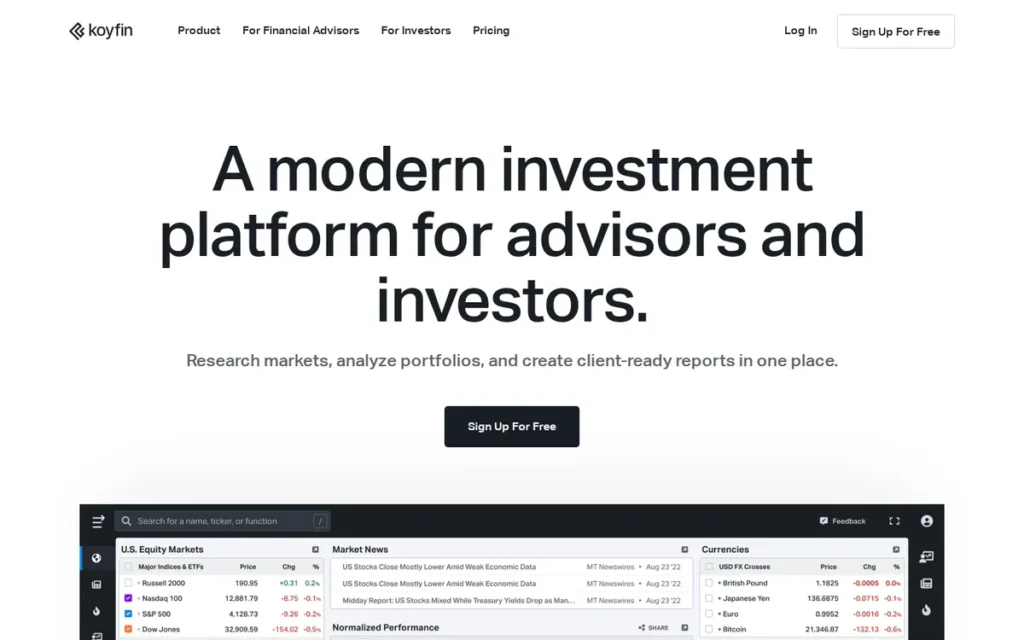
5. Koyfin: Best Low-Cost Alternative for Small RIAs and Independent Analysts
Category: Adviser Research & Reporting Platform, lower-cost tools for screening, model portfolios, proposals and branded client reports.
At a Glance
- Category: Adviser Research & Reporting Platform
- Best For: Solo and small RIAs and independent analysts priced out of enterprise platforms
- Price Range: Free tier plus paid plans (G2 list prices $0/$39/$79 per month, may change; Advisor Core $209/month and Advisor Pro $299/month, published list price)
- Primary Strength: Koyfin pairs the highest verified G2 rating in this list (4.8/5) with fully published pricing.
- Biggest Limitation: Koyfin has no proprietary fund ratings, cannot export screens to Excel and has light fixed-income coverage.
- One-Line Summary: Koyfin is the lowest-cost Morningstar Direct alternative in this list with adviser-grade fund data and published pricing, backed by a verified 4.8/5 G2 rating, but it has no proprietary fund ratings or institutional manager research.
- Last Verified: November 2026
Shortlist Score: 3.18/5 (C1 Coverage 2.5 · C2 Data 2.5 · C3 Reviews 5.0 · C4 Pricing 5.0 · C5 Adoption 2.0). Koyfin earns the top review and pricing-transparency scores. It ranks fifth because of limited data delivery (no Excel export of screens) and thin adoption evidence (3.05% T3 2025 share).
Overview Koyfin is a low-cost, browser-based research workspace with dashboards, charting, screening and ten years of financials. It is built for small RIAs and independent analysts who are priced out of enterprise platforms such as Morningstar Direct. Koyfin’s Advisor tiers add US and Canadian mutual fund data, model portfolios, proposals and custodian integrations.
Koyfin is the only product in this list that publishes full pricing for every plan, which makes Koyfin the easiest alternative to budget for.
Key Features
- Koyfin provides dashboards, charting and screening with 10 years of financials, estimates, transcripts and ETF holdings (Koyfin, 2026).
- Koyfin Advisor tiers add US and Canadian mutual fund data with a dedicated fund screener.
- Koyfin Advisor supports model and client portfolios, proposals and branded client reports.
- Koyfin integrates with custodians and portfolio systems including Schwab, Altruist, Fidelity Wealthscape, Black Diamond, Orion and Addepar.
- Koyfin Advisor Pro adds US SMA data, attribution, PDF statement upload and higher report limits.
Best For Koyfin is best for solo advisers, small RIAs under $100M AUM and independent analysts who need research and client reporting for under $5,000 a year.
Strengths
- Koyfin holds a verified G2 rating of 4.8/5 from 137 reviews, with 98.5% at 4 or 5 stars, the highest in this list (G2, November 2026).
- Koyfin’s top G2 pros are Ease of Use (24), User Interface (17) and Features (16), in contrast to Morningstar Direct’s 59 Poor Usability mentions (G2, November 2026).
- Koyfin is the only product among the seven with fully published pricing, with Advisor Core at $209/month (Koyfin pricing page, November 2026).
- Koyfin is among the low-cost tools growing with high satisfaction (Kitces AdvisorTech, 2025), and it holds a 3.05% share in T3’s survey (T3/Inside Information Software Survey, 2025).
Limitations Koyfin trades data depth for price and usability. Koyfin’s top G2 cons are Feature Deficiency (10), Limited Data (5) and Insufficient Data (5) (G2, November 2026), and Koyfin has no proprietary fund ratings or manager research.
- Koyfin reviewers report that they cannot export screening data to Excel, cannot screen ETFs, mutual funds and stocks together, and find fixed-income analysis light (G2, 2026).
- Koyfin’s UCITS ETF coverage is limited, which matters for UK and European advisers (QuantRoutine, 2026).
- Koyfin is a small company (estimated 11–50 staff), and its user and funding figures are unverified and conflicting (Prospeo, 2026).
How It Compares with Morningstar Direct
- Koyfin costs a fraction of Morningstar Direct and is easier to use, and its closest Morningstar comparison is Direct Advisory Suite.
- Koyfin is weaker than Morningstar Direct for proprietary fund ratings, analyst research, deep non-US fund coverage and institutional manager research.
- Koyfin is independent, and our research found no Morningstar ownership or data dependency.
Verdict Koyfin is the best-value Morningstar Direct alternative for small RIAs and independent analysts who need research, model portfolios and client reports at a published price. Koyfin’s verified 4.8/5 G2 rating shows that users value its ease of use, which is the area where Direct draws the most complaints. Teams that rely on Excel export, fixed income or UCITS funds should test those gaps during a trial.
6. Nasdaq eVestment: Best for Institutional Manager Selection and Separate Accounts
Category: Manager-Research Database, specialist databases of manager-reported institutional strategies, separate accounts and mandate intelligence.
At a Glance
- Category: Manager-Research Database
- Best For: Manager-selection, due-diligence and consultant teams, and asset managers tracking institutional mandates
- Price Range: Pricing on request (vendor-commissioned Forrester model, September 2026: about $346,900/year for Core + Market Lens; about $431,100 in year 1 with Omni Source)
- Primary Strength: Nasdaq eVestment covers 30,000+ manager-reported institutional strategies, including separate accounts, plus consultant and mandate intelligence.
- Biggest Limitation: Nasdaq eVestment relies on manager-reported data, is weak for retail funds and adviser reporting, and has the highest modelled cost in this list.
- One-Line Summary: Nasdaq eVestment is the strongest Morningstar Direct alternative for institutional manager selection and separate-account research, but it is expensive and weak for retail fund research and adviser reporting.
- Last Verified: November 2026
Shortlist Score: 3.13/5 (C1 Coverage 3.5 · C2 Data 3.5 · C3 Reviews 3.5 · C4 Pricing 1.0 · C5 Adoption 3.5). Nasdaq eVestment ranks sixth overall mainly because its modelled cost (C4 1.0) is the highest in this list. For manager-selection and separate-account work, treat it as the #1 choice.
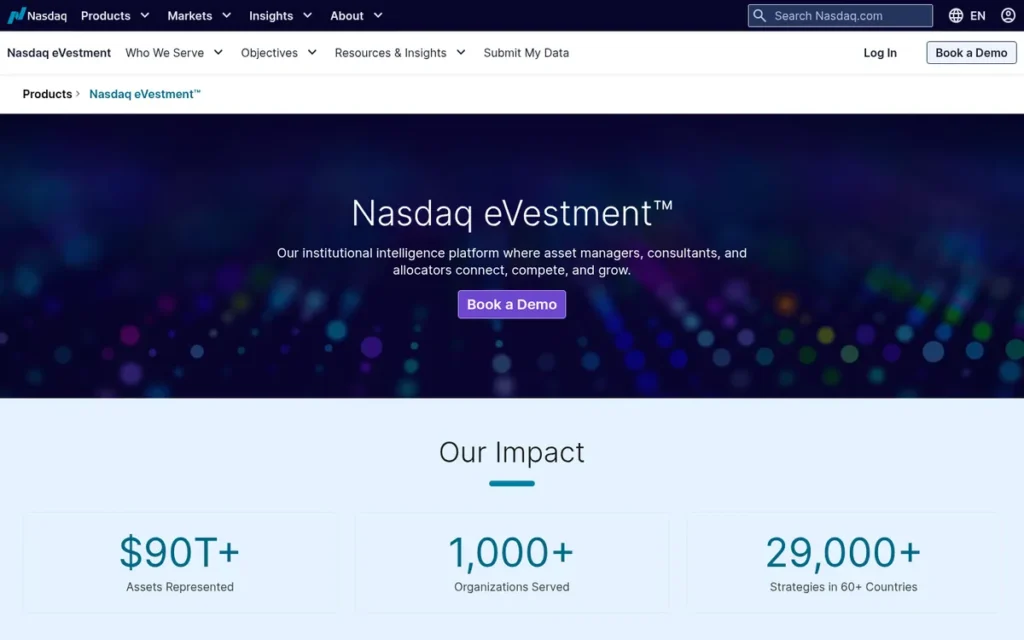
Overview Nasdaq eVestment is an institutional database of 30,000+ manager-reported strategies, including separate accounts. It is built for manager-selection, due-diligence and consultant teams that use Morningstar Direct mainly for manager research. Nasdaq eVestment adds peer-group analytics, holdings analysis and Market Lens mandate intelligence.
Nasdaq eVestment works as a consultant database for RFP and institutional search work, and Nasdaq eVestment’s data depends on managers reporting their own figures.
Key Features
- Nasdaq eVestment holds 30,000+ institutional strategies, including separate accounts, from 2,700+ actively reporting managers and 2,100+ hedge funds (Capterra, 2026).
- Nasdaq eVestment Market Lens tracks consultant ratings, mandates and searches at public and corporate plans, with fee and allocation intelligence.
- Nasdaq eVestment Analytics includes peer groups, Holdings Analysis and RiskPlus.
- Nasdaq eVestment integrates with Nasdaq Solovis for multi-asset portfolio analytics.
- Nasdaq eVestment reports multi-level verification across 20,000+ institutional plans (The Family Office Stack, 2026, vendor-reported).
Best For Nasdaq eVestment is best for institutional consultants, asset-owner manager-research teams and asset-manager distribution teams who need separate-account data, peer groups and mandate intelligence.
Strengths
- Nasdaq eVestment managers reported about $37 trillion in institutional assets across 28,000+ products (Nasdaq eVestment Institutional Intelligence Report, Q3 2024, vendor-reported).
- Nasdaq eVestment recorded 40,000+ product screens and 160,000+ profile views by consultants and investors in one quarter (Nasdaq eVestment Institutional Intelligence Report, Q3 2024, vendor-reported).
- Nasdaq eVestment covers separate accounts in depth, while Koyfin Advisor Pro (US SMAs) and YCharts (add-on) cover them only partly (Nasdaq and Capterra, 2026).
- Nasdaq eVestment reviewers on G2 praise its responsive support and market insights (G2 snapshot, 4.4/5, review count unconfirmed, 2026).
Limitations Nasdaq eVestment trades breadth for institutional depth and is weak for retail mutual funds, ETFs and adviser reporting. Nasdaq eVestment’s data depends on managers reporting their own figures, so managers who do not report are missing from its peer groups.
- Nasdaq eVestment reviewers cite slow loading and report creation, high cost, clunky usability, data-accuracy concerns and limited Asia coverage (G2, 2026).
- Nasdaq eVestment’s headline 244% ROI comes from a Nasdaq-commissioned Forrester study that models a composite asset manager built from interviews with four eVestment customers, and Forrester notes that actual results will vary (Forrester TEI commissioned by Nasdaq, 2026).
- Nasdaq eVestment publishes no pricing, and the only cost figures come from that vendor-commissioned model.
How It Compares with Morningstar Direct
- Nasdaq eVestment is stronger than Morningstar Direct for consultant, mandate and separate-account data.
- Nasdaq eVestment is weaker than Morningstar Direct for retail funds, ETFs and adviser reporting, and its modelled cost is far higher.
- Nasdaq eVestment has been owned by Nasdaq since a $705 million acquisition completed in October 2017, and it is independent of Morningstar (Reuters, 2017).
Verdict Nasdaq eVestment is the best Morningstar Direct alternative for institutional manager selection, separate accounts and consultant mandate intelligence. Nasdaq eVestment’s vendor-reported Q3 2024 universe covers about $37 trillion across 28,000+ products. A modelled $347,000–$431,000 annual cost suits heavy search desks, which should check the self-reported data against their own manager universe.
7. PitchBook: Best for Private-Markets Fund and Manager Research (Morningstar-Owned)
Category: Private-Markets Database, specialist data on private companies, deals, funds, LPs and GPs.
At a Glance
- Category: Private-Markets Database
- Best For: Private-markets diligence, LP and GP research, and teams adding private funds to public-fund analytics
- Price Range: Pricing on request (third-party price estimates: about $12,000–$20,000 for a single seat; $20,000–$40,000+ per user per year)
- Primary Strength: PitchBook has the best-supported private-markets fund, manager, deal and LP data among the seven products.
- Biggest Limitation: PitchBook does not replace Morningstar Direct’s public fund analytics or reporting, and Morningstar owns it.
- One-Line Summary: PitchBook is the strongest private-markets complement to Morningstar Direct, but because Morningstar owns it and it lacks public-fund analytics, it rarely works as a full replacement.
- Last Verified: November 2026
Shortlist Score: 3.03/5 (C1 Coverage 2.0 · C2 Data 4.0 · C3 Reviews 4.0 · C4 Pricing 2.0 · C5 Adoption 3.5). PitchBook ranks seventh overall because it replaces the fewest Direct jobs (C1 2.0). For private-markets fund and LP research, treat it as the #1 choice.
Overview PitchBook is a Morningstar-owned private-capital data platform. It covers private and public companies, deals, funds, LPs and GPs for teams that need private-markets fund and manager research alongside public-fund analytics. PitchBook also provides benchmarks, an Excel plug-in and data feeds.
PitchBook’s datasets are not automatically included in a Morningstar Direct subscription. PitchBook had about 1,800 clients when Morningstar agreed to acquire it in October 2016 (SEC filing, 2016).
Key Features
- PitchBook covers private and public companies, deals, investors, funds, LPs and GPs, with reported counts of 12.3M+ companies and 168K funds that vary by source (Softwr and Crustdata, 2026).
- PitchBook provides fund performance data, benchmarks, peer groups and private credit coverage.
- PitchBook collects data through AI ingestion, human validation and primary research, including surveys and FOIA requests to public LPs.
- PitchBook offers an Excel plug-in plus Direct Data feeds and APIs.
- PitchBook’s Navigator AI assistant and MCP connector bring PitchBook data into AI workflows.
Best For PitchBook is best for private-markets diligence teams, LPs evaluating GPs, and asset managers adding private funds and deal data to a public-fund research stack.
Strengths
- PitchBook ranked 6th on G2’s 2026 Best Financial Services Software list, up from 8th in 2025 (Business Wire, 2025; TMX, 2026).
- PitchBook holds a G2 rating of 4.5/5 from 224 to 271 reviews, depending on the snapshot (G2 snapshot, unverified, 2026).
- PitchBook combines AI ingestion with human validation and FOIA requests to public LPs, according to Morningstar (Morningstar investor Q&A, 2025).
- PitchBook reviewers praise its filtering, analysis and Excel export for research and market monitoring (Capterra, 2026).
Limitations PitchBook trades public-fund coverage for private-markets depth. PitchBook does not replace Direct’s mutual fund and ETF analytics or reporting, so most teams add PitchBook alongside Direct instead of switching to it.
- PitchBook is owned by Morningstar, so moving to PitchBook does little to reduce dependence on Morningstar, although it adds private-markets coverage.
- PitchBook reviewers call its cost “a barrier for small companies” and report stale contact and fund or investor data (Capterra, 2026).
- PitchBook’s FOIA-sourced and voluntarily reported fund performance data may not represent the whole market (PA PSERS research materials, 2018).
This aligns with community sentiment on r/startups:
“Yeah, and to be honest, I think a lot of data is incorrect and/or out of date. I know someone who paid USD$2000 to someone who said they had access to Pitchbook and did an extract of investors for them and their hit rate was literally 0, not even a single reply.” Posted by u/esseeayen
Takeaway: PitchBook’s investor contact data can go stale, so a pricey extract may produce little usable outreach unless buyers check it first.
How It Compares with Morningstar Direct
- PitchBook is stronger than Morningstar Direct for private companies, private funds, LPs and GPs.
- PitchBook is weaker than Morningstar Direct for public mutual fund and ETF analytics, peer groups and reporting.
- PitchBook became fully Morningstar-owned after Morningstar agreed in October 2016 to buy the roughly 80% it did not already own for about $180 million, valuing PitchBook at $225 million (SEC filing, 2016).
Verdict PitchBook is the best private-markets complement to Morningstar Direct for fund, manager, deal and LP research. PitchBook’s rise to 6th place on G2’s 2026 Best Financial Services Software list reflects strong user sentiment. Because Morningstar owns PitchBook and it lacks public-fund analytics, most teams will use it as an add-on rather than as a way out of Morningstar.
How Much Do Morningstar Direct Alternatives Cost?
Morningstar Direct alternatives range from Koyfin’s free tier and published $39–$299 monthly plans to a modelled $347,000–$431,000 per year for Nasdaq eVestment. Enterprise workstations typically cost about $12,000–$33,000 or more per user per year. Only Koyfin publishes full pricing, so the other figures are estimates rather than vendor quotes.
The cost range is more than 900-fold, from Koyfin’s $39 monthly Plus plan ($468 a year) to a modelled $431,100 first year for Nasdaq eVestment.
| Product | Annual Cost (per user unless noted) | Evidence Label | Source and Date |
|---|---|---|---|
| FactSet | About $12,000 base; $4,000–$50,000+; $40,000+ fully loaded | Third-party price estimate | GeminiQ, Tamarly (2026) |
| Bloomberg Terminal | $31,980 single; $28,320 each for 2+ | Third-party price estimate | ThePricer, BlueGamma (2025) |
| YCharts | About $6,000 first Professional user (conflicting $3,000–$6,300 reports) | Vendor-reported via third party; unverified | RFP.wiki; YCharts price sheet cited in an AI answer (2026) |
| S&P Capital IQ Pro | About $31,500–$33,375 list; $10,000–$50,000+ negotiated | Third-party price estimate | Investables.ai, CostBench (2026) |
| Koyfin | $0/$39/$79 per month (G2); Advisor Core $209/month; Advisor Pro $299/month | G2 list price (may change); Published list price | G2 (November 2026); Koyfin (November 2026) |
| Nasdaq eVestment | About $346,900/year firm-level; about $431,100 in year 1 with Omni Source | Vendor-commissioned | Forrester TEI commissioned by Nasdaq (September 2026) |
| PitchBook | $12,000–$20,000 single seat; $20,000–$40,000+ | Third-party price estimate | ProvaAPI, Prospeo (2026) |
Bloomberg Terminal’s reported prices agree across several independent pricing sources (ThePricer and BlueGamma, 2025). That consistency is why Bloomberg Terminal scores higher on pricing transparency than the other enterprise tools.
The best price-to-value choice depends on the type of buyer:
- Solo or small RIA: Koyfin Advisor Core ($209/month) includes one custodian integration and 10 client reports or proposals per month. Advisor Pro ($299/month) adds multiple integrations and up to 200 reports or proposals (Koyfin pricing page, November 2026).
- Mid-size adviser firm: YCharts adds proposals and stress tests at a reported $6,000 per year for the first Professional user (RFP.wiki, 2026).
- Institutional analytics team: FactSet, Bloomberg Terminal and S&P Capital IQ Pro sit in the $12,000–$33,000+ per-user range.
- Manager-research desk: Nasdaq eVestment’s modelled cost only makes sense for heavy institutional search work.
- Private-markets diligence: PitchBook is usually added alongside Direct rather than replacing it.
Contract terms change what buyers actually pay:
- Bloomberg Terminal usually requires two-year contracts.
- S&P Capital IQ Pro’s estimated list price is lower on a 2-year term.
- YCharts offers a 7-day free trial.
- Koyfin discounts annual billing by up to 30%, and Advisor Pro is 50% off in year 1 for firms under $100M AUM.
One 2026 Reddit commenter reports seeing firms add cheaper tools for junior or less intensive roles (r/bloomberg, 2026). That suggests a hybrid set-up: enterprise seats for heavy users and lower-cost tools for lighter users.
Which Alternatives Still Depend on Morningstar?
Three of the seven leading Morningstar Direct alternatives still involve Morningstar ownership or Morningstar data, so switching vendors does not always mean leaving Morningstar. PitchBook is Morningstar-owned, YCharts sells Morningstar fund data as an add-on, and FactSet’s marketplace carries Morningstar reports. Check ownership and data licences before signing.
- PitchBook: Morningstar has owned PitchBook since 2016 (SEC filing, 2016).
- YCharts: YCharts offers Morningstar enhanced fund data as an optional add-on.
- FactSet: FactSet’s open data marketplace includes third-party research such as Morningstar reports.
- Orion Risk Intelligence (unranked): Orion Risk Intelligence runs on Morningstar data, so it also keeps a firm inside the Morningstar ecosystem.
A team that cancels Morningstar Direct and buys PitchBook for private funds is still paying Morningstar. The spend has moved between two Morningstar products.
Our research found no Morningstar ownership or data dependency for Bloomberg Terminal, S&P Capital IQ Pro, Koyfin or Nasdaq eVestment.
When Does It Make Sense to Stay with Morningstar Direct?
Staying with Morningstar Direct makes sense when your work depends on Morningstar ratings, its category and peer-group framework, or fund-level attribution across its universe. Morningstar Direct’s top G2 pros are Data Accessibility (77) and Reporting (42), and none of the seven alternatives fully matches it on either (G2, November 2026).
- Teams that rely on Morningstar’s proprietary analyst ratings and research have no full equivalent among the seven alternatives.
- Teams built around Morningstar’s fund category and peer-group framework would need to rebuild their peer groups on another platform.
- Analysts who pull return strings from Morningstar Direct’s database, which Morningstar says covers more than 800,000 investments (Morningstar, 2026, vendor-reported), may lose coverage.
- Teams that depend on Morningstar Direct’s fund-level attribution bucketing should test it against any replacement before switching.
- Firms that generate compliant client reports at scale from Morningstar Direct risk having to rebuild their templates on another platform.
“If I had to choose between MSD and Bloomberg, with all data subscriptions on both I’d probably use MSD.” (u/kaiser8410, r/CFA (2017))
Takeaway: Practitioners who depend on fund return strings and attribution bucketing have historically preferred Morningstar Direct even over Bloomberg. This 2017 view predates the current versions of both platforms.
A hybrid set-up is often the practical choice. For example, a firm might keep Morningstar Direct seats for two fund analysts who depend on ratings and peer groups and move five lighter users to YCharts or Koyfin Advisor tiers. Total savings depend on the Direct quote, which is not public.
What Red Flags Should I Watch For When Evaluating Morningstar Direct Alternatives?
The main red flags in evaluating Morningstar Direct alternatives are:
- vendor-funded ROI claims
- alternatives that still run on Morningstar data
- quote-only pricing with no content inventory
- self-reported or stale data
- unverified non-US coverage
- multi-year contracts signed before a trial
Any one of these can wipe out the savings or coverage that prompted the switch.
Red Flag #1: Vendor-Commissioned ROI Studies The vendor pays for these studies, and they model a hypothetical composite customer. Their results are illustrations, not independent proof. Nasdaq eVestment’s 244% ROI comes from a Nasdaq-commissioned Forrester study built from four customer interviews (Forrester TEI commissioned by Nasdaq, 2026). Ask each vendor for references at firms like yours instead.
Red Flag #2: An Alternative That Still Runs on Morningstar Data An alternative that relies on Morningstar ownership or data may not reduce your cost or dependence. Three examples keep Morningstar in the stack: PitchBook is Morningstar-owned, YCharts offers an optional Morningstar enhanced fund data add-on, and Orion Risk Intelligence is built on Morningstar data. Check ownership and data licences before signing any contract.
Red Flag #3: Quote-Only Pricing With No Written Content Inventory Quote-only pricing without a written list of datasets makes value comparisons unreliable. Six of the seven products here lack full public pricing. Ask each vendor for a dated content inventory before you compare quotes, and check that it covers these points:
- The inventory should name every fund universe covered, including US funds, UCITS funds, SMAs and private funds.
- The inventory should state the data sources behind any ratings and categories.
- The inventory should set out your Excel and API rights.
- The inventory should list any limits on report templates.
- The inventory should price every add-on separately.
Red Flag #4: Self-Reported or Stale Data Self-reported or stale data weakens due diligence, because errors flow straight into peer groups and committee reports. Nasdaq eVestment depends on manager-reported figures, and PitchBook reviewers report stale data. Morningstar Direct itself has 35 G2 mentions of Data Inaccuracy (G2, November 2026). Spot-check vendor figures against your own records.
Red Flag #5: Unverified Non-US Coverage Unverified non-US coverage often breaks international workflows after a switch, especially for UCITS funds, Asian managers and fixed income. Koyfin’s UCITS ETF coverage is limited, and reviewers complain about Nasdaq eVestment’s Asia coverage (G2, 2026). Test your actual non-US and fixed-income universe during any trial.
Red Flag #6: Locked-In Multi-Year Contracts Before a Trial A multi-year contract signed before a hands-on trial locks in cost before you know whether the platform covers your workflows. Bloomberg Terminal usually uses two-year terms, and S&P Capital IQ Pro’s estimated price is lower on a 2-year term (ThePricer, 2025; Investables.ai, 2026). Run your own tasks on any platform before you commit.
What Questions Should I Ask Before Choosing a Morningstar Direct Alternative?
Start with three questions: which Direct jobs your team uses every week, which Morningstar product you are replacing, and whether the new platform can reproduce your reports. Then ask about Excel and API export, coverage of your universe, any remaining Morningstar licence and how saved work will migrate. Finish with a two-week pilot.
Question #1: Which Morningstar Direct jobs does my team use every week? List the Morningstar Direct jobs your team uses every week before you compare vendors. A tool that covers your three most-used jobs is a better fit than one with more features overall. Common weekly jobs include:
- Fund-research teams screen funds and ETFs.
- Portfolio teams run performance attribution.
- Manager-selection teams run manager due diligence.
- Most teams produce client or committee reports.
Question #2: Am I replacing Direct or Direct Advisory Suite? Morningstar Direct and Direct Advisory Suite serve different users, so the right shortlist depends on which one your team licenses. Institutional Direct users should compare FactSet, Bloomberg Terminal, S&P Capital IQ Pro and Nasdaq eVestment. Advisory Suite users (formerly on Advisor Workstation) should compare YCharts and Koyfin.
Question #3: Can the platform reproduce my top three client or committee reports? A vendor demo should rebuild your three most important client or committee reports using your own data, not sample portfolios. Branded templates, compliance wording and peer-group comparisons are often the hardest parts to recreate. Check them line by line against your current Morningstar Direct output.
Question #4: Can I export screens and peer groups to Excel or an API? Export ability decides whether your downstream models, risk tools and committee packs keep working after a switch. FactSet, S&P Capital IQ Pro and PitchBook document Excel add-ins or plug-ins. Some G2 reviewers report that Koyfin screens cannot be exported to Excel (G2, 2026). Test exporting one real peer group during any trial.
Question #5: Does the vendor’s coverage include my SMA, private-market and non-US fund universe? Check coverage claims against your actual holdings list, including separate accounts, private funds and non-US funds. Among the seven, Nasdaq eVestment has the deepest documented separate-account coverage. Koyfin Advisor Pro (US SMAs) and the YCharts add-on cover them partly. PitchBook and S&P Capital IQ Pro cover private markets.
Question #6: Will I still need a Morningstar data licence after switching? A remaining Morningstar licence cuts into any savings from switching. Ask whether the ratings, categories or fund data you rely on would come from a Morningstar add-on, such as YCharts’ Morningstar enhanced fund data. Get the add-on priced in writing before you compare total costs.
Question #7: How will saved lists, peer groups, custom data points and templates migrate? Vendors rarely document publicly how saved lists, peer groups, custom data points and report templates migrate, and our research found little evidence on how much effort it takes. Before signing, ask each vendor for written migration support terms, including who rebuilds your templates and by when.
How should I run a two-week pilot? Cover your three most-used Direct jobs in a two-week test:
- Export one real peer group to Excel and check the data against Morningstar Direct.
- Rebuild one client or committee report and compare it with your current output.
- Check coverage for 20 holdings from your own universe, including any SMAs and non-US funds.
How Did We Rank These Morningstar Direct Alternatives?
Shortlist Tools scored seven Morningstar Direct alternatives from 1 to 5 on five weighted criteria:
- Direct workflow coverage (30%)
- data delivery (25%)
- review sentiment (15%)
- pricing transparency (15%)
- documented adoption (15%)
Every score uses dated, labelled evidence. The overall rank shows evidence strength, and the workflow table is the main decision tool.
Why each criterion matters:
- C1: Coverage of Morningstar Direct’s Core Workflows (30%): No platform replaces all of Direct, and every job a tool does not cover has to be rebuilt somewhere else.
- C2: Data Breadth, Depth and Delivery (25%): Workflows break on coverage and export, and 51% of wealth firms cite integration as a pain point (Wipfli, 2025).
- C3: Review-Platform Sentiment and Evidence Quality (15%): Reviews are the most independent signal available, so G2 figures that exist only as unverified snapshots were capped at 4.0.
- C4: Pricing Transparency and Value (15%): Opaque quotes make budgeting hard, so published prices score highest.
- C5: Documented Adoption, Scale and Retention (15%): Adoption evidence lowers switching risk, and audited filings count for more than vendor-reported figures.
This is Shortlist Tools’ editorial scoring, last verified November 2026. Weighted total = C1×0.30 + C2×0.25 + C3×0.15 + C4×0.15 + C5×0.15.
| Rank | Product | C1 | C2 | C3 | C4 | C5 | Weighted Total |
|---|---|---|---|---|---|---|---|
| 1 | FactSet | 4.0 | 5.0 | 3.5 | 2.0 | 5.0 | 4.03 |
| 2 | Bloomberg Terminal | 3.0 | 5.0 | 4.0 | 2.5 | 4.5 | 3.80 |
| 3 | YCharts | 3.5 | 3.0 | 4.0 | 3.5 | 3.5 | 3.45 |
| 4 | S&P Capital IQ Pro | 2.5 | 4.5 | 3.5 | 2.0 | 4.0 | 3.30 |
| 5 | Koyfin | 2.5 | 2.5 | 5.0 | 5.0 | 2.0 | 3.18 |
| 6 | Nasdaq eVestment | 3.5 | 3.5 | 3.5 | 1.0 | 3.5 | 3.13 |
| 7 | PitchBook | 2.0 | 4.0 | 4.0 | 2.0 | 3.5 | 3.03 |
Ranks 4 to 7 are within 0.3 points of each other. Manager-selection readers should treat Nasdaq eVestment as their #1, and private-markets readers should treat PitchBook as theirs.
Every figure in this article carries an evidence label:
- “Verified G2 (Nov 2026)” marks ratings checked directly on G2 this month.
- “G2 snapshot (unverified)” marks G2 figures taken from third-party copies.
- “G2 list price (may change)” and “Published list price” mark prices shown by G2 or by the vendor.
- “Third-party price estimate” marks prices reported by pricing sites or buyers.
- “Vendor-reported” and “Self-listed award” mark claims that come from the vendor itself.
- “Vendor-commissioned” marks studies paid for by the vendor, such as the Nasdaq-commissioned Forrester TEI.
Candidates were screened as follows:
- Bloomberg Terminal and Koyfin were kept from G2’s Morningstar Direct alternatives list.
- FactSet, S&P Capital IQ Pro, Nasdaq eVestment, PitchBook and YCharts were added because buyers name them most often.
- Seven products on G2’s alternatives list serve unrelated jobs and were excluded: Acquire.com, Ideagen Audit Analytics, Nitrogen, Betterment Advisor Solutions, Carta Fund Management, Irwin and Macrobond.
- AlphaSense holds a verified G2 rating of 4.6/5 from 369 reviews (G2, November 2026), but it has no fund database, so it was not ranked.
- Kwanti, Orion Risk Intelligence and LSEG Workspace had too little web evidence to score.
Our research has known limits:
- Verified G2 data covers only Morningstar Direct, Bloomberg Terminal, Koyfin and AlphaSense. The G2 figures for FactSet, YCharts, S&P Capital IQ Pro, Nasdaq eVestment and PitchBook are snapshots with conflicting review counts.
- We could not use Reddit evidence for Nasdaq eVestment, PitchBook, YCharts or Koyfin, and we could not read the Bloomberg-specific threads, so we do not claim community consensus.
- Our research found no named S&P Capital IQ Pro client case studies with quantified outcomes, and we could not confirm the 2026 T3 figures for YCharts that appear in AI answers.
Shortlist Tools has no affiliate relationships with any company listed, and rankings are determined entirely by research data and objective evaluation criteria.
What Do Buyers Commonly Ask About Morningstar Direct Alternatives?
Buyers most often ask which alternative suits financial advisers, which suits institutional manager research, and how Shortlist Tools ranks products. The short answers are YCharts for advisers and Nasdaq eVestment for manager research. Our rankings come from five weighted, evidence-labelled criteria scored from 1 to 5.
What is the best Morningstar Direct alternative for financial advisers?
YCharts is the best Morningstar Direct alternative for most financial advisers who need research, proposals and client reports in one platform. YCharts was a T3 2025 Software All-Star in Investment Data & Analytics with an 8.37/10 rating (T3/Inside Information Software Survey, 2025). Advisers on tight budgets should compare Koyfin, which publishes full pricing.
What is the best Morningstar Direct alternative for institutional manager research?
Nasdaq eVestment is the best Morningstar Direct alternative for institutional manager research and separate accounts. It covers 30,000+ manager-reported strategies and adds consultant and mandate intelligence through Market Lens (Capterra, 2026). It is expensive: a vendor-commissioned Forrester model puts Core plus Market Lens at about $346,900 per year (Forrester TEI commissioned by Nasdaq, 2026).
How does Shortlist Tools determine its rankings?
Shortlist Tools scores each product from 1 to 5 on five weighted criteria: workflow coverage (30%), data delivery (25%), review sentiment (15%), pricing transparency (15%) and adoption (15%). Every figure carries a dated evidence label, such as Verified G2 or Third-party price estimate. The full scorecard appears in the methodology section above.
What Do Key Morningstar Direct Alternative Terms Mean?
Buyers comparing research platforms run into licensing, analytics and data-quality terms that affect both cost and fit. The definitions below explain the terms used in this article in plain language, along with why each one matters when you evaluate a vendor or compare written quotes.
ASV (Annual Subscription Value): ASV is the annualised value of a vendor’s active subscription contracts. High ASV retention shows that existing clients keep renewing, which suggests lower switching risk.
Performance Attribution: Performance attribution breaks a portfolio’s return down into the decisions that caused it, such as allocation and security selection. Committee reporting and manager evaluation depend on accurate attribution.
Separate Account (SMA): A separately managed account is a portfolio a manager runs for a single client instead of pooling it in a fund. SMA coverage varies widely between platforms, so check it if your firm uses them.
Peer Group: A peer group is a set of comparable funds or strategies used to judge relative performance. The way a vendor builds peer groups affects every ranking and report it produces.
Return String: A return string is a time series of periodic returns for a fund, index or asset class. Analysts pull return strings into risk models, so export limits matter.
UCITS: UCITS is the European regulatory framework for funds sold to retail investors. UK and European advisers should confirm that UCITS funds and ETFs are well covered.
LP and GP: A limited partner (LP) invests in a private fund, and a general partner (GP) manages it. Private-markets platforms are judged on how complete their LP, GP and fund performance data is.
FOIA-Sourced Data: FOIA-sourced data is obtained through public-records requests, usually to public pension plans. It may not represent the whole private-markets universe.
Vendor-Commissioned ROI Study: A vendor-commissioned ROI study is paid for by the vendor and often models a hypothetical composite customer. Buyers should treat its results as illustrations, not independent proof.
Content Inventory: A content inventory is a written list of every dataset, coverage universe and add-on included in a quote. Without one, price comparisons between vendors are unreliable.
Data Feed and API: A data feed or API delivers data straight into a firm’s own systems without going through a desktop interface. These are often licensed separately and can add significant cost.
Per-Seat Licence: A per-seat licence charges for each named user. Hybrid set-ups that give lighter users cheaper tools can lower total per-seat spending.
Which Morningstar Direct Alternative Is Right for You?
Key Insights
- The right Morningstar Direct alternative depends on the workflow you rely on most, because no single platform consistently replaces every Direct job.
- FactSet is the strongest overall alternative for institutional portfolio analytics, with audited ASV retention above 95% (FactSet FY2025 10-K, 2025).
- YCharts is the best fit for advisers who need proposals and reports. Koyfin is the lowest-cost option in this list, with a verified 4.8/5 G2 rating and published pricing.
- Nasdaq eVestment leads institutional manager selection and separate accounts, while PitchBook is a Morningstar-owned private-markets add-on.
- Enterprise prices for every alternative except Koyfin are third-party estimates or vendor-commissioned models, so written quotes and a two-week pilot are essential.
Which tool fits depends on your situation:
- Teams that depend on Morningstar ratings, categories and fund-level attribution should stay with Morningstar Direct or run a hybrid set-up.
- Teams that need real-time multi-asset risk should consider Bloomberg Terminal.
- Teams that need company, deal and private-company data should consider S&P Capital IQ Pro.
Shortlist Tools reviews these platforms every quarter and updates the “Last Verified” date on every entry. Read our full methodology above, or see our other independent reviews of investment research platforms. We update this guide quarterly. Last updated: November 2026.